Press Release Email: Examples, Template + Subject Lines That Get Opened
A press release email is a short message that puts your news in front of a journalist. It pairs a brief personal pitch with the press release pasted below it. The best ones share three traits: a short subject line, a pitch under 200 words, plus a clear reason why that exact reporter should care. A strong press release email can turn one announcement into dozens of stories. A weak one gets deleted in seconds, often unread.
Key Takeaways
- 83% of journalists prefer to be pitched one to one by email, which makes a personal press release email more effective than mass blasts, phone calls, or social media DMs.
- Keep the pitch under 200 words. That is the length 65% of journalists say they want, with the full release pasted below it, never attached.
- Subject lines of ten words or fewer earn more than double the response rate of long ones. State the news plainly in the first four words.
- Send mid-morning, Tuesday to Thursday, in the reporter's time zone. Follow up exactly once, 3 to 5 days later, in the same thread.
- Relevance decides everything: 79% of journalists reject pitches that miss their beat, so 10 well-matched reporters outperform 1,000 random contacts.
This guide covers the whole process. It shows how to send a press release via email, which subject lines get opened, plus a copy-paste template with real examples. Every rule here is backed by published survey data from more than a thousand journalists, not guesswork. Read it once, then keep the templates at the end for your next announcement.
What Is a Press Release Email?
A press release email is a message sent to a journalist that introduces a news announcement. It has two parts: a short personal note at the top that explains why the story fits the reporter's beat, plus the full press release pasted in the body below it. It is the standard way brands share news with the media.
Email is not just one option among many. It is the channel journalists ask for. In Muck Rack's State of Journalism survey, 83% of journalists said they prefer to be pitched one to one by email rather than by phone or a mass blast. Reporters live in their inboxes. Meet them there, on their terms, with a message built for a fast read.
One thing a press release email is not: a newsletter. It goes to a small, hand-picked list of reporters. Each message is addressed to one person. Blasting the same note to 500 addresses in the BCC field is the fastest way to get marked as spam.
Media Pitch vs Press Release: What Is the Difference?
People mix these terms up all the time, so it helps to separate them. The media pitch vs press release question comes down to this: the pitch is the personal note, while the release is the formal document. The pitch sells the story to one reporter. The release carries the full facts for any reporter.
| Media pitch | Press release | |
| Purpose | Convince one journalist the story fits their beat | Deliver the complete, official facts of the news |
| Length | Under 200 words | 300 to 500 words |
| Voice | Personal, written for one reader | Formal, written in third person |
| Audience | A specific reporter or editor | Any journalist, plus the public |
| Where it lives | The top of your email | Pasted below the pitch, plus your newsroom page |
A press release email combines both. The pitch goes on top, then the release follows. The pitch answers "why you, why now." The release answers "what, who, when, where." Skip the pitch and the reporter has no reason to scroll. Skip the release and they have nothing solid to write from.
Before You Hit Send: Three Checks
Most pitches fail before the send button is pressed. The story is thin, the release is sloppy, or the list is wrong. Three checks prevent that.
1. Make sure the release itself is ready
The email only opens the door. The release has to hold up once a reporter reads it. It needs a clear headline, a strong first paragraph with the key facts, a quote, plus a short boilerplate. If the release is not there yet, study proven press release examples first, then come back to the outreach step.
2. Check the story is actually newsworthy
A story is newsworthy when it is new, timely, or matters to the outlet's readers. Fresh data, a first-of-its-kind launch, a notable partnership, a local angle on a national trend: these earn coverage. A minor website update or an internal milestone does not. When the news is thin, hold it until there is a stronger hook, or bundle it with original data that gives reporters something to cite.
3. Build a small, targeted media list
Relevance beats reach. In the same Muck Rack survey, 79% of journalists named lack of relevance as the top reason they reject a pitch. Ten reporters who cover your exact beat will outperform a thousand random contacts. Read each reporter's last three stories before adding them to the list. Media database tools can speed this up; this breakdown of Muck Rack covers when a tool makes sense versus when it is overkill.
How to Find Journalists' Email Addresses
A targeted list is useless without working addresses. The good news: most journalist emails are findable in minutes, for free. Work through these methods in order.
- Check the outlet's staff page. Many publications list writers with their emails. Start at the outlet's "About", "Team", or "Contact" page.
- Check the byline or author bio. Click the reporter's name on any article. Author pages often show an email or a contact form.
- Check their social profiles. Many reporters put their email in their X or LinkedIn bio, precisely because they want pitches by email instead of DMs.
- Look at their newsletter. Reporters who run newsletters usually send them from a real, replyable address.
- Use a media database. Paid tools maintain verified contact lists with beats plus recent stories. Worth it at volume, overkill for a single launch.
- Guess the pattern, then verify. Most outlets use one format, like firstname.lastname@outlet.com. Confirm your guess with a free email verifier before sending, since bounces hurt your sender reputation.
Whatever the method, record where each reporter was found plus what beat they cover. That context feeds the personal line of the pitch later. A list of 15 verified, well-matched contacts is a real asset. A scraped list of 500 is a liability.
How to Send a Press Release via Email (Step by Step)
Here is how to send a press release via email, from finished release to follow-up:
- Step 1: Finalize the press release. Headline, dateline, key facts up top, a quote, boilerplate.
- Step 2: Build a targeted list of 10 to 30 journalists who cover your exact topic.
- Step 3: Write the subject line first. Short, specific, news up front.
- Step 4: Write a personal pitch of under 200 words. Name their recent work. State why this story fits their beat.
- Step 5: Paste the full release below the pitch. Never send it as an attachment.
- Step 6: Send one email per reporter, mid-morning on a Tuesday, Wednesday, or Thursday.
- Step 7: Follow up once, after 3 to 5 days, with a short reply in the same thread.
Two of these steps trip people up most. The attachment rule exists because many newsrooms block or distrust attachments from unknown senders, so a pasted release always gets seen while an attached one often does not. The one-email-per-reporter rule exists because journalists can see a mass blast from a mile away. A pitch that opens with their name plus their recent story reads like a colleague. A pitch that opens with "Dear Sir or Madam" reads like spam.
Press Release Subject Lines That Get Opened
The subject line does more work than any other line in the email. Reporters triage hundreds of messages a day, so the decision to open or delete happens in about a second. A good press release subject line states the news plainly, leads with the most specific detail, plus stays short enough to survive a phone screen.
Short is not a style choice. It is measured. Propel's Media Barometer, built from hundreds of thousands of real pitches, found that pitches with the shortest subject lines earn more than double the response rate of pitches with the longest ones. Aim for ten words or fewer. Cut every word that does not carry news.
A few rules for a press release email subject line:
- Front-load the news. The first four words should carry the story, since phones cut off the rest.
- Be specific. Numbers, names, or places beat vague claims. "Raises $4M" beats "exciting funding news".
- Label it when useful. A prefix like "Press release:" or "Story idea:" tells busy reporters exactly what they are opening. Data on this is mixed, so test both.
- Skip clickbait. No ALL CAPS, no "URGENT", no fake mystery. Reporters delete tricks on sight.
- Match their beat in the wording. A tech reporter opens for the product. A local reporter opens for the neighborhood.
Five formulas cover almost every announcement. Each one leads with the concrete detail a reporter can picture:
- The plain news formula: [Who] + [did what] + [notable detail]. Example: "Fern & Grounds moves all packaging to compostables, a year early." Boring on purpose. Clarity wins opens.
- The data formula: New data: [surprising stat about a group]. Reporters need numbers to build stories, so a strong stat is its own hook.
- The local formula: [City or region] + [first / biggest / newest] + [thing]. Local outlets exist to cover exactly this shape of story.
- The question formula: A short question the reporter's readers are already asking. Use sparingly; it works only when the question is genuinely live on their beat.
- The exclusive formula: Exclusive for [outlet]: [story]. The strongest opener there is, but only offer an exclusive to one reporter at a time, then honor it.
Here is a swipe file of 20 subject lines built on those formulas. Swap in your own facts:
| Scenario | Subject line |
| Product launch | Press release: [Brand] launches first [product category] for [audience] |
| Product launch | [Brand]'s new [product] cuts [task] time by [X]% |
| Funding | [Brand] raises $[X]M to [mission in five words] |
| Funding | Story idea: why investors just backed [category] with $[X]M |
| Data / study | New data: [X]% of [group] now [surprising behavior] |
| Data / study | [Industry] report: [key stat] (full data inside) |
| Event | [City] hosts [event name], [date]: [one-line hook] |
| Event | Media invite: [event] with [notable speaker], [date] |
| Local angle | [City] startup [does notable thing], first in [region] |
| Local angle | How [national trend] is playing out in [city] |
| Partnership | [Brand A] and [Brand B] partner to [outcome] |
| New hire | [Known name] joins [Brand] as [role] |
| Milestone | [Brand] hits [milestone]: what it signals for [industry] |
| Award | [Brand] named [award] winner among [X] entries |
| Book / music / film | [Creator]'s [work] out [date]: the story behind it |
| Nonprofit | [Nonprofit] to [impact] for [group] by [date] |
| Trend comment | Expert source: [name] on [breaking industry topic] |
| Exclusive | Exclusive for [outlet]: [one-line story] |
| Embargo | Embargoed until [date]: [one-line story] |
| Follow-up | Re: [original subject line] |
The Press Release Email Template That Works
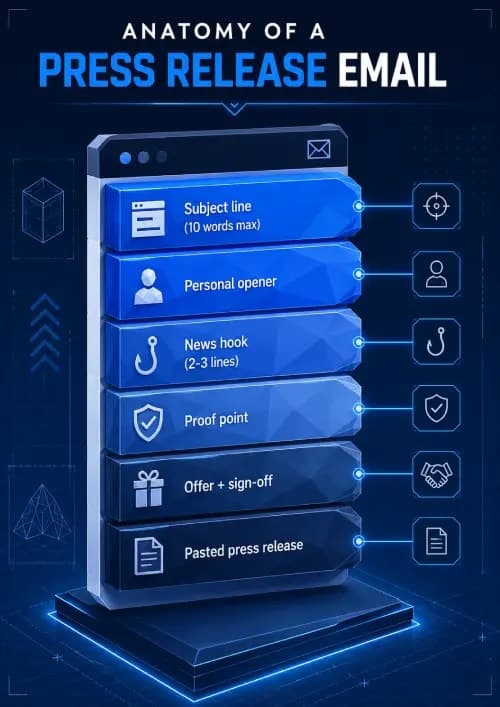
Journalists have told the industry what they want, in numbers. In the Muck Rack survey cited above, 65% of journalists said they prefer pitches under 200 words. So the template below is short on purpose. Every line has one job. This press release email template works for launches, funding, events, hires, plus almost any other announcement:
Subject: [News in ten words or fewer]

Hi [First name],

[1 line: a genuine reference to their work. "Your piece on X made a point about Y that stuck with me."]

[2-3 lines: the news plus why it fits their beat. "Today [Brand] announced X, the first Y for Z. Given your coverage of A, I thought the B angle might interest your readers."]

[1-2 lines: proof. A number, a customer, a named partner, or a data point that makes the story solid.]

The full press release is below. Happy to set up a call with [spokesperson name/title], or send [images / data / early access].

Thanks for your time,
[Name]
[Title, Company]
[Phone number]

---

[FULL PRESS RELEASE PASTED HERE]
Why each part earns its place:
- The personal line proves a human wrote this for them. It must be specific to their work. "I love your writing" is filler; naming a real article is proof.
- The news lines carry the story in plain words. No buzzwords, no "revolutionary", no "game-changing". State what happened plus who it affects.
- The proof line gives the reporter something concrete to anchor the story: a stat, a name, a dollar figure.
- The offer line lowers the effort of saying yes. Interviews, images, or data mean the reporter can build a fuller story fast.
- The pasted release means everything they need is one scroll away. No downloads, no links to chase, no security warnings.
Press Release Email Examples: Good vs Bad
Templates make more sense with a real press release email example next to them. Here is a filled-in version, followed by the kind of pitch that gets deleted.
A good press release email example
Subject: Riverside cafe chain swaps all packaging for compostables

Hi Maria,

Your piece last month on Riverside's plastic ban covered the cost
squeeze on small food businesses really well.

Today, Fern & Grounds (4 cafes in Riverside) announced it has moved
100% of its packaging to compostables, becoming the first local chain
to meet the ban's rules a full year early. The owner has hard numbers
on what the switch cost, which speaks directly to the cost question
your article raised.

She is available for interviews this week, plus we have photos of the
rollout. Full press release below.

Thanks for your time,
Dana Cole
Communications, Fern & Grounds
(555) 210-8842

---

[FULL PRESS RELEASE]
Why this press release pitch example works: the subject states the news in nine words. The opener names the reporter's actual article. The news paragraph connects the announcement to a question she already covers. The proof is concrete: four cafes, 100% of packaging, a year early. The offer removes friction with interviews plus photos, ready now.
A bad press release email example
Subject: EXCITING ANNOUNCEMENT FROM A GAME-CHANGING BRAND!!

Dear Sir/Madam,

We are thrilled to announce that our revolutionary company is
disrupting the industry with an innovative new offering! Please
find our press release attached. We believe this would be a
perfect fit for your publication.

Please confirm receipt of this email.

Best regards,
The Marketing Team
Every line here fails. The subject is all caps with no news. The greeting proves a mass blast. The body says nothing concrete: no product, no name, no number. The release is attached, so it may never be seen. The sign-off demands work from the reporter instead of offering help. This is the template for the delete key.
Product launch pitch example
Launches are the most common announcement, which means the most competition in the inbox. The pitch has to answer one question fast: why does this product matter to anyone beyond the company that built it?
Subject: First budgeting app built for gig workers launches today

Hi Jordan,

Your coverage of gig economy pay gaps keeps coming back to one
problem: unpredictable income. That is the exact problem Steadily,
launching today, is built around.

It is the first budgeting app that plans around variable income
instead of a fixed salary. 2,300 gig workers used the beta; early
users smoothed their month-to-month spending swings by 41%.

The founder (a former rideshare driver) is available this week, plus
we can share the beta data. Full press release below.

Thanks,
Sam Rivera
PR, Steadily
(555) 830-1194
Event pitch example
Event pitches double as invitations. Give the date early, name the draw, then make attending or covering it effortless.
Subject: Media invite: 40 robotics teams compete in Austin, March 14

Hi Priya,

Since you covered the state robotics grant last fall, this seemed
like a natural follow-up: the first Central Texas Robotics Open runs
March 14 at the Convention Center, with 40 school teams competing.

Three of the teams were funded by that grant, so the event doubles
as a progress report on the program you wrote about.

Press passes are ready, plus we can arrange interviews with team
captains and organizers on site. Full details in the release below.

Thanks,
Alex Chen
Central Texas Robotics Open
(555) 442-7765
Local news pitch example
Local outlets are the most approachable targets for small businesses. The bar is different: the story does not need to be big, it needs to be local. Lead with the place, not the product.
Subject: Maple Street bookstore turns 50, plans free block party

Hi Terrence,

The Corner Page on Maple Street turns 50 this month, making it the
oldest bookstore in the county. The family that opened it in 1976
still runs it today, now in its third generation.

They are marking it with a free block party on June 8, with 12 other
Maple Street businesses joining in.

The owners have great stories (plus photos going back to opening
day) and are happy to talk. Release below.

Thanks,
Ruth Okafor
(555) 615-3320
Notice what all three share. Each press release pitch example opens with a line tied to the reporter's own beat, states the news inside two sentences, offers proof with real numbers, then closes with easy access to people plus assets. The topics differ; the skeleton never does.

Sending a Press Release Email to Local Media
Local outlets deserve their own playbook, because they work differently from national ones. Staff are small, beats are broad, plus the bar for coverage is proximity rather than scale. For a small business, the local paper, the regional TV station, or the neighborhood news site is usually the fastest route to a first story.
- Pitch the person, not just the desk. Most local outlets publish a news desk address like news@outlet.com. Send there as a backup, but the better move is finding the reporter who covers business, education, or community events by reading a week of their coverage.
- Lead with the place. The first line of the subject should name the city, street, or neighborhood. Local editors scan for geography first, topic second.
- Offer faces plus visuals. Local TV needs something to film; papers need someone to quote and photograph. Say who will be on camera plus what the visual moment is.
- Connect to a running local story. A new ordinance, a downtown revival, a school program. A release that advances a story the outlet already covers is an easy yes.
- Respect small-staff timing. Weekly papers often close their issue days before print. Ask, or send at least a week ahead of your date.
The local news pitch example earlier in this guide shows the shape: place first, human story second, logistics handled. Local coverage also syndicates upward more often than people expect, since national reporters mine local outlets for trend stories.
When to Send a Press Release Email
Timing matters less than most guides claim, but it still matters. In the Muck Rack survey, 64% of journalists said they have no preferred day, while 44% said they prefer to get pitches in the morning. The practical read: obsess less over the perfect day, more over the morning window plus the days to avoid.
| Timing question | What journalists report | Practical rule |
| Best day | 64% have no day preference | Tuesday to Thursday is the safe zone |
| Best time | 44% prefer morning pitches | Send between 9 and 11 am, their time zone |
| Days to avoid | Inboxes empty out late Friday | Skip Friday afternoon, weekends, holidays |
| Big news days | Major events bury small stories | Move your date when big news is scheduled |
For time-sensitive news, an embargo helps. Send the release a few days early with "Embargoed until [date]" in the subject line. Reporters get time to prepare a story, while your news still lands on your schedule. Honor the embargo yourself: do not post the news anywhere public before that date.
How to Follow Up Without Burning the Contact
Silence is normal. It rarely means no. It usually means buried. The follow-up rules are simple, again straight from journalists themselves: in the Muck Rack survey, 51% said follow up exactly once, ideally 3 to 5 days after the first email. Daily reminders get senders blocked.
Keep the follow-up inside the same email thread so the original pitch sits right below it. Add something if possible: a new stat, a fresh angle, an updated deadline. A template:
Subject: Re: [original subject line]

Hi [First name],

Following up on the note below in case it got buried. One quick
update since I wrote: [new detail, stat, or angle].

[Spokesperson] is still available this week if the story is a fit.
Either way, thanks for reading.

[Name]
[Phone number]
If the second email gets no reply, let it go. Pitch that reporter again next time with a different story. A polite miss keeps the door open. A pushy streak closes it for good.
What to do when a reporter says yes
A reply changes the clock. Reporters work on deadlines measured in hours, so a slow answer can lose the story you just won. Respond the same day, ideally within the hour. Deliver exactly what was promised: the interview slot, the images, the data. Keep the spokesperson briefed with three key points so the quote lands. After the story runs, send a one-line thank you, share the piece, then add the reporter to a short list of warm contacts for the next announcement. Coverage compounds through these relationships more than through any single release.
The Pre-Send Checklist
Before any campaign goes out, run the email against this list. Thirty seconds here prevents most of the failures covered in this guide.
- The story passes the newsworthy test: new, timely, or clearly relevant to this outlet's readers.
- The release is final: headline, key facts in paragraph one, a quote, boilerplate, contact info.
- Every reporter on the list covers this exact beat, verified against their recent stories.
- The subject line is ten words or fewer, news first, no caps or hype.
- The pitch is under 200 words with a personal opener naming their work.
- One proof point is included: a number, a name, or a data point.
- The full release is pasted below the pitch. No attachments anywhere.
- Each email is addressed to one reporter. No visible CC, no mass BCC.
- Assets are ready to send on request: images, data, spokesperson availability.
- The send is scheduled for mid-morning, Tuesday to Thursday, in the reporter's time zone.
- A follow-up reminder is set for 3 to 5 days out, one follow-up only.
7 Press Release Email Mistakes That Kill Coverage
- Sending attachments. Many newsrooms filter or distrust them. Paste the release in the email body every time.
- Mass BCC blasts. Reporters spot template blasts instantly. One personal email per reporter, always.
- Pitching past 200 words. Long pitches read as work. Cut until only news, proof, plus the offer remain.
- Pitching the wrong beat. The top rejection reason by far. Read their last three stories before you send anything.
- Clickbait subject lines. Caps, hype, or mystery earn instant deletes. State the news plainly.
- Burying the news. If the announcement first appears in paragraph three, it does not exist. Lead with it.
- Following up more than once. One follow-up after 3 to 5 days. After that, silence is the answer.
How to Measure Whether Your Press Release Email Worked
Most guides stop at the send button. That leaves the most useful step out: measuring what happened, so the next round improves. Four numbers tell the story.
| Metric | How to track it | What a healthy number looks like |
| Open rate | Email tracking in your outreach tool | Journalist open rates average roughly a third of pitches, so beating that means your subject lines work |
| Reply rate | Count replies per campaign, even the "not for me" ones | Average response rates sit in the low single digits; 5%+ on a targeted list is strong |
| Placements | Google News plus mention-monitoring alerts for your brand | Any earned story is a win; note which pitch angle earned it |
| Downstream lift | Referral traffic, backlinks, brand searches in your analytics | A slow build in the weeks after coverage, not a one-day spike |
Two habits make these numbers useful. First, log every campaign in a simple sheet: date, list size, subject line, opens, replies, placements. Patterns appear by the third campaign, like one beat replying twice as often or one subject formula earning double the opens. Second, treat polite rejections as wins. A reporter who replies "not this time, but keep me posted" just gave permission for the next pitch.
Press Release Email or Distribution Service: Which Do You Need?
Direct email is not the only way to get a release out. Wire and distribution services push announcements to networks of outlets at once. The two approaches solve different problems, so the honest answer is often both.
| Direct press release email | Distribution service | |
| Best for | Earning real stories from targeted reporters | Wide syndication, timestamped announcements, investor visibility |
| Reach | 10 to 30 hand-picked journalists | Hundreds of outlets at once |
| Personalization | Full, one email per reporter | None, same release everywhere |
| Typical result | Fewer, deeper placements with a real byline | Many syndicated copies, fewer original stories |
| Time cost | High: research, writing, follow-ups | Low: submit once |
A practical rule: when the goal is a journalist actually writing about the news, direct email wins, because original stories come from relationships plus relevance. When the goal is broad, fast visibility, or when there is no time for outreach, a distribution partner carries the load. Companies with real news plus no PR staff usually get the best result from a managed service that does the targeting and pitching for them.
Turn One Email Into Real Coverage
A press release email is a small document with a big job. The mechanics in this guide cover what the data supports: a short, specific subject line, a personal pitch under 200 words, the release pasted below, a morning send, one patient follow-up. Teams that follow those rules consistently see replies where they used to see silence.
The payoff extends past the story itself. Earned coverage builds backlinks plus brand searches, which is a large part of why press releases help SEO when the story is real news. Each placement also starts a relationship, so the second pitch to that reporter is warmer than the first.
Doing this well takes time: list building, personalization, follow-ups, tracking. Businesses that would rather stay focused on the product often hand outreach to a distribution partner; agencies such as Savon PR run this exact process at scale. Either way, the standard is the same. Send emails a journalist would thank you for.
Get the Free Press Release Email Pack
The copy-paste pitch template, a follow-up template, 30 subject lines, plus the pre-send checklist.
Frequently Asked Questions
How do you write a press release email?
Write a subject line that states the news in ten words or fewer. Open with one personal line about the reporter's work. Explain the news plus why it fits their beat in two or three lines. Add one proof point, offer interviews or assets, then paste the full press release below your signature.
What is a good subject line for a press release?
A good press release subject line is short, specific, plus news-first. Data from Propel's Media Barometer shows the shortest subject lines earn more than double the response rate of the longest ones. Lead with the most concrete detail: a number, a name, or a place. Avoid caps, hype words, or vague teases.
Should you attach a press release to an email or paste it?
Always paste it. Put your short pitch at the top of the email, then paste the full press release below it. Attachments from unknown senders get blocked by newsroom filters or ignored for security reasons, so an attached release often never gets read at all.
How long should a press release email be?
Keep the pitch portion under 200 words; 65% of journalists surveyed by Muck Rack said they prefer pitches under that length. The pasted press release below it should run 300 to 500 words. Together that keeps the whole email readable in under a minute.
When is the best time to send a press release email?
Mid-morning, Tuesday through Thursday, in the journalist's own time zone. Surveys show 44% of journalists prefer morning pitches while most have no strong day preference. Avoid Friday afternoons, weekends, holidays, plus days when major scheduled news will crowd out smaller stories.
How many times should you follow up with a journalist?
Once. In Muck Rack's survey, 51% of journalists said a single follow-up is right, ideally 3 to 5 days after the first email. Reply in the same thread, keep it short, add one new detail if you can. If there is still no answer, save that contact for your next story.
Can you send the same press release to multiple journalists?
Yes, the release itself can go to many reporters. The pitch on top cannot. Each email should be sent individually, addressed by name, with an opener tied to that reporter's own coverage. Never put multiple journalists in the same email, whether in CC or BCC. If you offer anyone an exclusive, it goes to one reporter only.
What should you not include in a press release email?
Leave out attachments, links that require downloads, ALL CAPS, hype words like "revolutionary", read receipts, plus any request that creates work, such as "please confirm receipt". Skip images embedded in the email body too, since they trigger spam filters; offer them on request instead. Everything a reporter needs should be readable as plain text in one scroll.
Sources
- PR Daily: By the numbers, what journalists really think of your pitches (Muck Rack State of Journalism data)
- Propel Media Barometer: pitch response rates by subject line length
- Muck Rack: The State of Journalism 2026 (survey of nearly 1,100 journalists)
About the author: Written by the Savon PR team, who help brands earn press coverage across a network of more than 1,250 media outlets.