
Do Press Releases Help SEO? What Actually Works in 2026
Do press releases help SEO? Yes, but not the way they once did. A press release does not lift search rankings on its own, and the links placed inside a distributed release pass little or no ranking value. What a press release can do is earn attention. When a real journalist or blogger picks up the news and writes about it, that earned coverage brings referral traffic, brand mentions, and natural backlinks. Those are the signals that actually help SEO. So the honest answer is that press releases support SEO indirectly, as a way to get noticed, not as a link-building shortcut.
This guide explains how press releases help SEO today, what Google really does with press release links, and how to write, distribute, and measure a release so it earns the kind of coverage that moves rankings.
What a press release is in SEO terms
A press release is a short, newsworthy announcement that a brand sends to journalists and media outlets. It shares something worth reporting, such as a launch, a funding round, a hire, a study, or a partnership. On its own, a press release is a public relations tool, not a ranking tool.
In SEO terms, it helps to split a release into two parts. The first is the owned copy, which is the release itself as it appears on a newswire or on the brand's own newsroom page. The second is the earned coverage, which is the set of articles that journalists choose to write after they read the news. The owned copy rarely moves rankings. The earned coverage is where the SEO value lives, because it brings editorial links, fresh referral traffic, and mentions of the brand across trusted sites.
This is the core idea behind press release SEO: the release is the spark, and the coverage it earns is the fuel. A release that nobody reports on does very little for search. A release that earns ten genuine stories can send real signals to Google for months. Keeping that split in mind changes how you write, where you send a release, and how you judge whether it worked.
Do press releases still help SEO in 2026?
They do, but the playbook has changed. Ten years ago, marketers treated press releases as a cheap way to build links. They wrote a release, stuffed it with exact-match keywords, added links pointing back to money pages, and pushed it out to dozens of sites. For a while it worked. Then Google closed the loophole.
Today, Google discounts the links inside a syndicated release, and it treats keyword-heavy press release links as a form of spam. So the question "do press releases work for SEO" has a more careful answer than it used to. The direct, mechanical benefit is mostly gone. The indirect benefit, which comes from real people reading the news and acting on it, is alive and well.
The brands that still win with press releases are the ones that treat each release as news first and search second. They focus on being worth covering. When the coverage comes, the SEO value follows. The brands that still chase links inside the release itself get little in return, and sometimes invite trouble. The shift is simple to state and harder to live by: stop optimizing the release for Google, and start optimizing it for the reporter who decides whether to write the story.
Newsworthy news versus thin announcements
Because coverage drives the SEO value, the angle of the news matters more than any keyword. Journalists ignore thin updates and respond to real stories. The table below shows how to turn weak announcements into ones a reporter can use. The pattern is the same each time: add proof, a result, or a wider point that readers care about.
| Thin announcement | Stronger, newsworthy angle |
| We redesigned our website | We surveyed 1,000 customers and rebuilt our site around what they said was broken |
| We hired a new manager | An industry veteran joins to lead a new division, with a clear plan and a market reason |
| We launched a product | A product that solves a specific, named problem, with early results or a customer proof point |
| We won an award | The award tied to a trend or a data point that says something about the wider market |
None of these stronger angles needs a single keyword to work. They earn coverage because they give a reporter something true and useful to tell. That coverage is what carries the search value back to the site.
How press releases help SEO
When a release earns attention, it supports search in four connected ways. None of them is a magic ranking button. Together, they build the authority and traffic that Google rewards over time. The more coverage a release earns, the stronger each of these signals becomes.
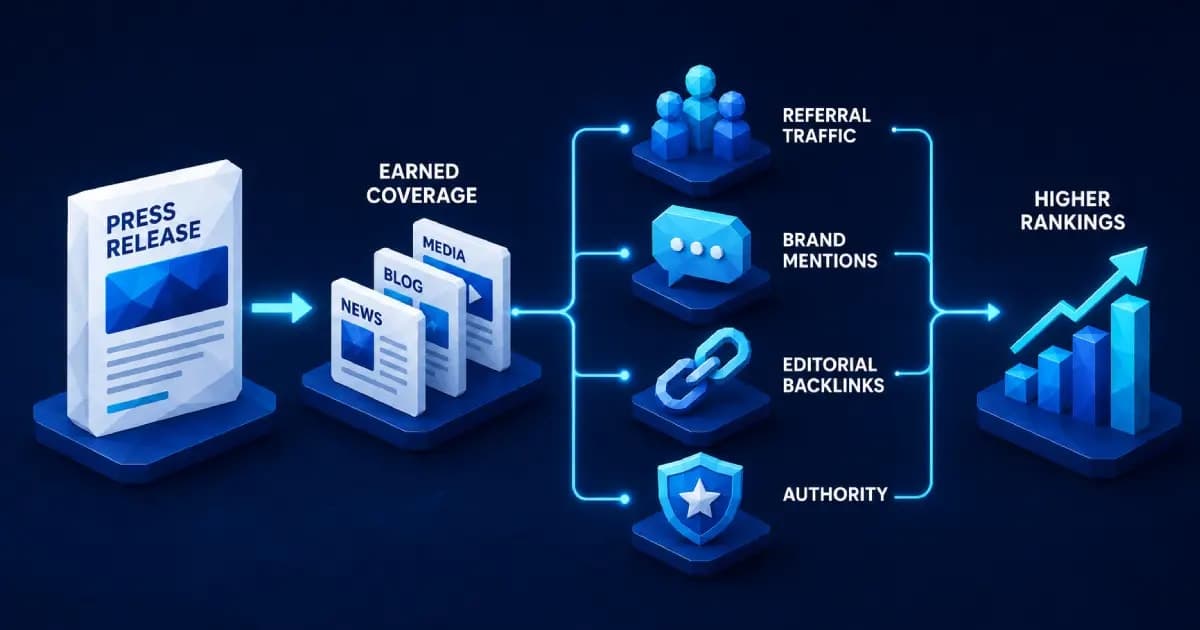
Referral traffic from media pickups
The clearest benefit is referral traffic. When a journalist writes about the news and links to the brand's site, readers click through. That traffic is often well matched to the brand, because the reader was already interested in the topic. Even when a link is not followed for ranking purposes, the visit is real. People land on the site, read, sign up, and sometimes buy. Strong referral traffic also tends to grow branded search, as readers later look up the brand by name, and branded search is one of the steadiest signals of a healthy, known business.
Brand mentions and online visibility
Not every story includes a link. Many simply name the brand. These unlinked mentions still matter. They spread the brand name across trusted sites, which helps search engines and AI tools understand who the brand is and what it does. Wide, consistent mentions build the kind of recognition that supports rankings for branded terms and lends weight to the whole site. This is one reason seo friendly press releases focus on a clear, repeatable brand story rather than a single keyword. When every story describes the brand the same way, the picture search engines form is sharper.
Earned backlinks, done the right way
The most valuable outcome is an editorial backlink. This is a link that a writer adds because it helps their reader, not because the brand asked for it. These press release backlinks come from the coverage, not from the syndicated release. They carry real weight because they reflect a genuine editorial choice, often from a site with strong authority of its own.
Here is the key distinction. Links inside the distributed release should be marked so they do not pass ranking credit. Links that a journalist adds on their own, inside a story they chose to write, are normal editorial links and are the ones Google values most. The goal of a release is to earn the second kind by being newsworthy enough to report. One strong editorial link from a respected outlet can be worth more than dozens of placed links that Google ignores.
Brand authority and trust signals
Coverage in respected outlets builds authority. When credible sites report on a brand, they help establish its expertise and trustworthiness, which align with the qualities Google describes in its quality guidance. A pattern of real coverage tells both readers and search engines that the brand is a known voice in its field. That reputation makes every other page on the site easier to rank, because the whole domain looks more trusted. Earning media features is also one of the most reliable ways to build brand trust with both readers and search engines. Authority built this way is slow but durable, and it is hard for competitors to copy.
How the SEO value flows: a simple example
Imagine a small software company that runs a study on remote work and shares the results in a release. The release itself sits on a wire and gets few direct clicks. That part does almost nothing for SEO. The value starts when the study is interesting enough to report.
A trade publication writes about the findings and links to the full study on the company's site. Two newsletters mention the data without a link. A blogger embeds one chart and credits the company. Within a week, the study page is earning referral traffic, the brand name is appearing across several trusted sites, and one strong editorial link is pointing at the site. Over the next months, search engines recrawl that coverage, the study page starts to rank for related terms, and branded searches tick up. None of this came from the links inside the release. All of it came from news worth covering.
What Google actually says about press release links
It helps to read Google's own words rather than rely on old advice. Google's spam policies list link schemes as a violation, and they specifically name "links with optimized anchor text in articles or press releases distributed on other sites" as an example of link spam. In plain terms, putting keyword-rich links in a release you push out across many sites is exactly the pattern Google warns against.
Google has also been clear about how to handle links you do not vouch for. Its guidance on qualifying outbound links explains that paid or placed links should carry a rel attribute such as sponsored or nofollow, so they do not pass ranking credit. A distributed press release falls into this group, which is why the links inside it should be qualified rather than treated as normal endorsements.
This is not new. Years ago, Google stated that links in a press release should be nofollow, much like links in an advertisement, because a release is a message the brand controls. The takeaway is steady and current: do not expect the links inside a release to act like editorial votes. Expect value from the coverage the release earns, where journalists link on their own terms.
How to make a press release SEO-friendly
You cannot force rankings with a release, but you can make one far more likely to earn coverage and the SEO value that follows. The steps below cover how to optimize a press release for SEO without crossing into spam.
- Lead with real news. Ask whether a reporter would care. A launch, a result, a data point, or a notable hire can be news. A vague update is not. Newsworthiness is the single biggest driver of pickups, so spend most of your effort here.
- Use keywords naturally. Include the terms your audience searches, but write for people first. A natural phrase in the headline and opening is fine. Repeating an exact keyword many times, or forcing it into links, reads as spam and can backfire.
- Write a headline and lead that work twice. The headline should grab a busy journalist and also read well in search. The first paragraph should answer who, what, and why it matters, so a reader gets the point in seconds.
- Link safely and sparingly. Point to a relevant page on your site, such as a product page or a study, and keep links to a few. Qualify the links in the distributed copy so they follow Google's guidance.
- Add multimedia and structured detail. Include an image, a chart, a quote, and clear contact details. Releases with usable assets get picked up more often, because they make a reporter's job easier.
- Distribute where it can earn attention. A wire can create reach, but a focused pitch to reporters who cover your space often earns better stories. The aim is a real journalist choosing to write, not a list of syndicated copies. Deciding between a PR tool and a PR agency can shape how you reach the right reporters.
Brands that follow these press release seo best practices tend to earn more coverage, and the coverage is what carries the search value. The order matters too: get the news and the targeting right first, then refine the wording for search.
Once the release is ready, how you send it matters just as much. This guide to the press release email covers subject lines, a copy-paste template, plus follow-up rules journalists actually respond to.
SEO press release checklist
Use this quick checklist before you send a release. It folds the steps above into a fast review you can run in a few minutes.
- The news passes a simple test: a reporter who does not know the brand would still care.
- The headline is clear, specific, and readable in search.
- The first paragraph answers who, what, and why it matters.
- Target keywords appear naturally, not stuffed, and never forced into links.
- Links point to relevant pages and are qualified in the distributed copy.
- An image or chart, a real quote, and contact details are included.
- A focused list of relevant journalists is ready, not just a wide blast.
- A plan is in place to track coverage, links, referral traffic, and mentions.
Get the Complete Free Press Release SEO Toolkit
A pre-send checklist, a newsworthy-angle guide, a measurement plan, and a fill-in press release template.
How to measure press release SEO success
Because the value is indirect, you measure a release by the coverage and signals it earns, not by rankings alone. The benefits of press release submission in seo show up across several metrics, so track them together rather than one at a time. The table below maps each metric to a tool and what it tells you.
| Metric | Where to check it | What it tells you |
| Media pickups | Google News, manual search, media monitoring | How many outlets reported the news |
| Earned backlinks | A backlink tool such as Ahrefs or Semrush | How many editorial links the coverage created |
| Referral traffic | Analytics (referral and source reports) | How many visitors the coverage sent |
| Branded search | Google Search Console | Whether more people search the brand by name |
| Brand mentions | Media monitoring or alerts | How widely the brand name spread, linked or not |
| Rankings over time | Search Console and a rank tracker | Whether authority gains lift related pages |
Looking at press release submission in seo through these metrics keeps expectations honest. A single release rarely changes rankings overnight. A steady program of newsworthy releases, each earning coverage, builds links and mentions that lift the whole site over months. Track a release for at least eight to twelve weeks, since the slower SEO gains arrive well after the first day of pickups.
Press releases and AI search
Search now includes AI answers, such as Google's AI Overviews and tools like ChatGPT and Perplexity. These systems build answers from what trusted sources say across the web. That gives press releases a fresh role that most older guides miss, and it reflects a wider shift in how AI is disrupting the PR industry.
When credible outlets report on a brand, those stories become part of the pool that AI systems read and cite. Clear, factual coverage with consistent details makes a brand easier for an AI to understand and repeat. The same habits that help traditional search, which are real news, accurate facts, and wide trustworthy mentions, also help a brand show up in AI answers. A release that earns honest coverage is now feeding two systems at once, classic search and AI search.
There is a practical lesson here. Keep the facts in every release simple and consistent, such as the brand name, what it does, key numbers, and a clear quote. When the same accurate details appear across many stories, both search engines and AI systems can repeat them with confidence. Vague or shifting details do the opposite, and leave a brand harder to summarize.
Common mistakes that get a release ignored
Most releases fail for the same few reasons. Avoiding them is often the difference between silence and coverage.
- No real news. A release with nothing newsworthy gets deleted. Lead with something a reporter can use.
- Keyword stuffing. Forcing keywords and exact-match links reads as spam and can trigger Google's link spam signals.
- Treating links as the goal. Chasing links inside the release misses the point. The coverage is the prize.
- A wide blast with no targeting. Sending the same copy to everyone earns less than a focused pitch to the right reporters.
- Burying the news. If the point is in the third paragraph, a busy reporter never reaches it. Lead with it.
- No follow-up or tracking. Without measurement, you cannot tell what worked or build on it.
How press release SEO compares to other link strategies
Press releases are one of several ways brands try to earn links and authority. It helps to see where they fit next to the alternatives, because each one has a different payoff and a different risk. The table below compares the common options side by side.
| Strategy | What it is | SEO value | Main risk |
| Press releases | Newsworthy announcements that earn media coverage | Indirect, through earned coverage, mentions, and editorial links | No coverage if the news is thin |
| Digital PR | Data studies and stories built mainly to earn links | High when the asset is genuinely interesting | Slow and resource heavy to produce |
| Guest posting | Writing articles for other sites | Moderate, when the site is relevant and trusted | Reads as spam at scale, against Google guidance |
| Directories and citations | Listing the business on directories | Low, mostly useful for local trust signals | Little ranking lift on their own |
| Buying links | Paying for links that pass ranking credit | None that is safe | A clear violation that can trigger penalties |
Read this way, press releases sit closest to digital PR. Both rely on earning attention rather than placing links. The difference is focus. A press release centers on a timely announcement, while digital PR often centers on a data study or a story built to be linked. Many brands use both, with releases for news moments and digital PR for evergreen, linkable assets.
The strategies to avoid are the ones that try to shortcut trust. Buying links and mass guest posting both run against Google's guidance and can cost far more than they return. A press release earns its value the same way digital PR does, by giving people a real reason to write. That is slower than paying for a link, but it is durable, and it does not put the site at risk.
So how should a brand choose? A simple rule helps. Use a press release when there is genuine news, such as a launch, a result, or a hire that the market would care about. Use digital PR when there is no news but there is data or insight worth sharing, since a strong study can earn links for years. Skip the shortcuts, because the short-term gain rarely survives Google's spam systems. Used together, news releases and linkable assets give a brand a steady flow of coverage, mentions, and editorial links, which is exactly the mix that builds lasting search authority.
The bottom line
So, do press releases help SEO? Yes, when you treat them as news rather than a link tactic. A release will not rank a page by itself, and its built-in links carry little weight. The value comes from the coverage it earns, which brings referral traffic, brand mentions, editorial backlinks, and authority. Focus on being worth reporting, follow Google's guidance on links, and measure the signals the coverage creates. Do that consistently, and press releases become a steady contributor to search visibility, not a shortcut, but a genuine source of the trust and attention that rankings are built on.
Frequently Asked Questions
Do press releases still help SEO in 2026?
Yes, but indirectly. A press release does not raise rankings by itself, and its built-in links pass little value. The help comes from the coverage it earns. When journalists report the news, that brings referral traffic, brand mentions, and editorial backlinks, which are the signals that support SEO.
Are press release backlinks nofollow?
Links inside a distributed release should be qualified, such as nofollow or sponsored, so they do not pass ranking credit. Google treats keyword-rich links in syndicated releases as link spam. The valuable links are the editorial ones that journalists add on their own when they write about the news.
Do press release links pass link juice?
The links inside the release itself generally do not pass ranking value, because they are controlled by the brand and should be qualified. Editorial links from independent coverage do pass value, since a writer chose to add them. That is why earning coverage matters more than placing links in the release.
What makes a press release newsworthy?
A newsworthy release gives a reporter something true and useful to tell, such as new data, a real result, a notable hire, or a launch that solves a specific problem. The test is simple: would a journalist who does not know the brand still care? If the answer is no, the angle needs work before it goes out.
Are press releases worth it for SEO?
They can be, if the news is genuinely newsworthy and earns real coverage. A single release rarely changes rankings. A steady program of newsworthy releases builds links, mentions, and referral traffic that lift the whole site over time, alongside the wider PR and brand benefits.
How long does it take for a press release to help SEO?
Referral traffic and mentions can appear within days of pickup. The SEO gains from earned links and authority build more slowly, often over weeks or months, as search engines recrawl the coverage and credit the site. Consistent releases compound the effect over time.
Sources
- Google Search Central, Spam Policies for Google Web Search
- Google Search Central, Qualify Outbound Links for SEO
- Search Engine Land, Google: Links In A Press Release Should Be Nofollowed
About the author: Written by the Savon PR team, who help brands earn press coverage across a network of more than 1,250 media outlets.
More PR Guides & Tips Articles
View all →